
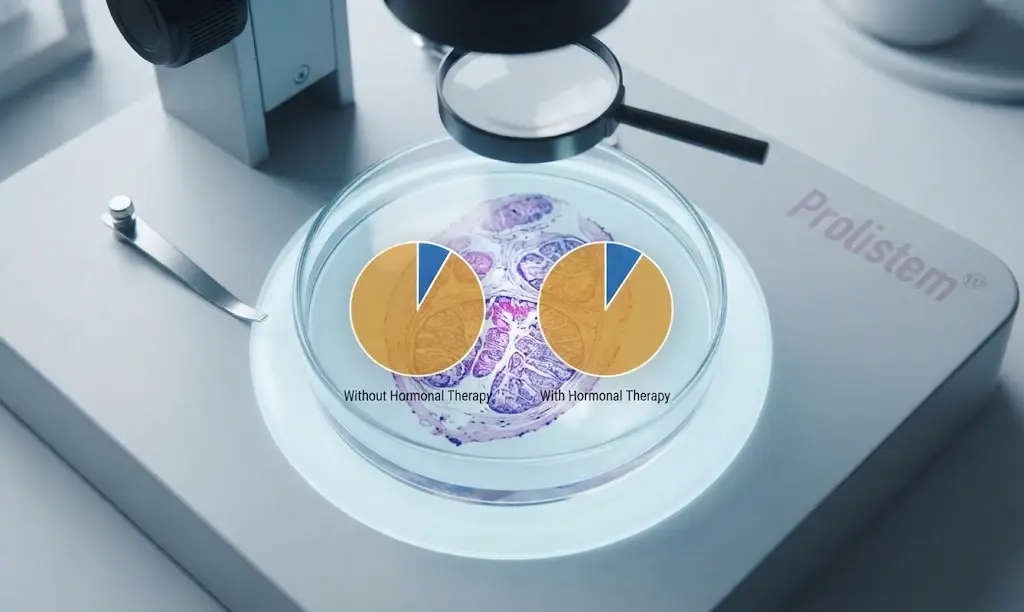
A new study published in Andrology (2026) investigated whether increasing testosterone levels before micro-TESE could improve the chances of finding sperm in men with non-obstructive azoospermia (NOA).
Researchers at the University Hospital of Münster, Germany, analyzed data from 1,256 men who underwent micro-TESE.
Men included in the study
Overall sperm retrieval success rate
Almost half of the men had low testosterone. Of those, 301 received hormonal treatments, including hCG, anastrozole, clomiphene, tamoxifen, or combinations.
The surprising finding: Hormonal treatment successfully increased testosterone levels, but it did not significantly improve the chances of finding sperm during micro-TESE.
Among men with low testosterone:
| Patient group | No hormonal treatment | With hormonal treatment |
|---|---|---|
| Normal chromosomes (46, XY) | 37.4% | 30.5% |
| Klinefelter syndrome (47, XXY) | 30.1% | 21.1% |
Neither treated-versus-untreated difference was statistically significant. These numbers do not prove hormonal treatment reduces success, because patients were not randomly assigned to treatment.
Higher testosterone does not necessarily mean better sperm production. Improving testosterone levels in the blood was not enough to improve sperm retrieval.
FSH alone cannot reliably predict success. Men with high FSH may still have sperm found during micro-TESE.
Age matters in Klinefelter syndrome. Younger patients generally had better sperm retrieval outcomes.
Hormonal treatment can still be useful. It may help men who have symptoms of low testosterone, even when it does not improve fertility outcomes.
Many men with azoospermia believe that increasing testosterone will automatically help their testicles produce sperm.
This study suggests that the situation is much more complicated.
The problem may not simply be low testosterone. In some men, the testicles have underlying damage that cannot be corrected by increasing hormone levels alone.
The researchers concluded that conventional hormonal treatment should not routinely be used solely to improve micro-TESE success in men with NOA.
This retrospective study cannot definitively establish that hormonal therapies have no benefit in every patient. It also did not evaluate Prolistem or other treatments with different proposed mechanisms.
Increasing testosterone does not necessarily restart sperm production. Treating azoospermia requires understanding why sperm production has stopped, not simply correcting hormone levels.
One important difference from the previous article: the earlier study examined a second micro-TESE after a failed first attempt, while this study examined whether hormonal treatment before micro-TESE improved sperm retrieval. Their success rates should not be directly compared.
Source: Anfosso et al. “Can Hormonal Therapy Improve the Outcomes of mTESE in Patients With Non-Obstructive Azoospermia?” Andrology, 2026;14:1859–1872. DOI: 10.1111/andr.70292.
Would you like a matching Instagram image for this article, highlighting the central finding that raising testosterone did not improve sperm retrieval success?
Testosterone Inhibition of Spermatogonial Differentiation and Male Infertility…
Genetics of Azoospermia Genetic Causes of Azoospermia. Azoospermia…
As a man, maintaining good reproductive health is…
Treatment for low count sperm: Effective Solutions for…
Foods That Improve Male Fertility Foods that improve…
Understanding Zero Sperm Count: Causes, Diagnosis, and Treatment…