Can sperm still be found after a Sertoli-cell-only diagnosis?
Sertoli-cell-only syndrome, or SCOS, means that the examined testicular tissue contained Sertoli cells but no visible developing germ cells. However, an important point is often overlooked: a biopsy examines only a small portion of the testis.
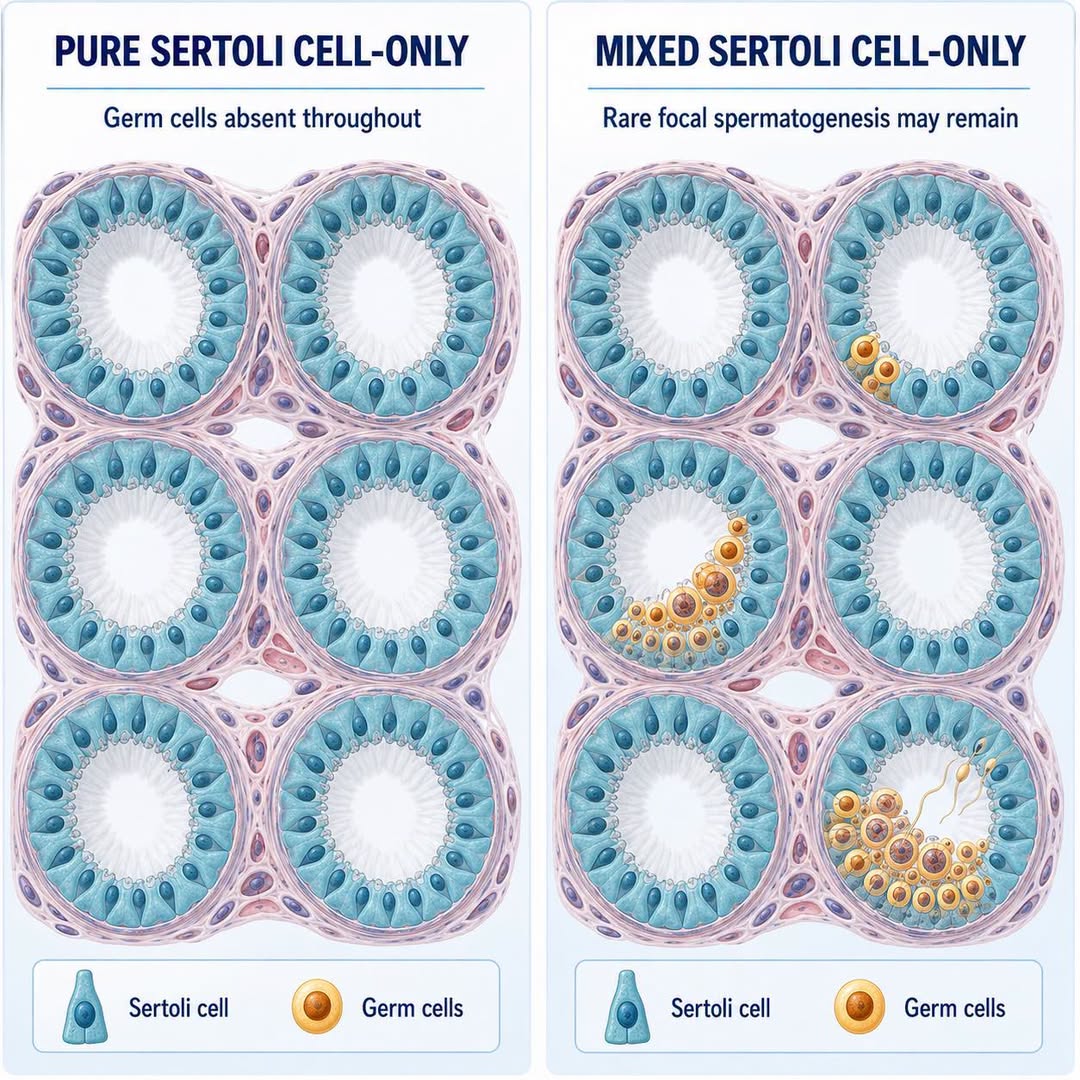
SCOS has traditionally been described in two patterns:
The pure or congenital pattern is believed to occur when germ cells fail to develop or reach the testis. If germline stem cells are truly absent throughout both testes, producing or retrieving sperm would not be expected.
The secondary or mixed pattern develops after germ cells have been lost over time because of genetic, hormonal, toxic, inflammatory, or other testicular damage. In these men, a biopsy may show only Sertoli cells in one area while rare spermatogonial stem cells or small islands of sperm production remain elsewhere.
This focal pattern explains why sperm can sometimes be found by microTESE even after an earlier biopsy reported Sertoli-cell-only histology. Therefore, SCOS is a serious diagnosis—but it does not always mean that the possibility of finding sperm is zero.
Men with Sertoli-cell-only histology have been included in Prolistem clinical studies, and sperm was retrieved in some treated patients. Prolistem is intended to support the testicular environment and the remaining spermatogenic cells when they are still present. However, no treatment can create germ cells when they are completely absent, and success cannot be guaranteed.
The recommended treatment period and retrieval strategy must be evaluated individually according to the complete clinical picture—including medical history, genetic testing, hormone levels, testicular volume, biopsy findings, and previous sperm-retrieval procedures. FSH is useful information, but it cannot by itself confirm whether sperm are present or predict the outcome.
A Sertoli-cell-only result should be evaluated carefully—not treated as an automatic reason to lose hope.
Contact us to learn whether Prolistem may be appropriate before your next sperm-retrieval procedure.